
If you’re adding a thicker PPF to your range, start with what changes during fitting. Moving from 7.5 to 8.5 or 9.5 mil puts more material over the paint. It can also take more work to guide that material around a tight corner and finish the return cleanly. You’re choosing both a protective film and the work your team will need to install it.
Compare PPF Thickness at 7.5, 8.5 and 9.5 Mil
This PPF thickness comparison chart shows the main gains and tradeoffs when you compare films with similar TPU, coating and adhesive constructions.
| PPF thickness | Main advantage | Main tradeoff | Installer focus |
|---|---|---|---|
| 7.5 mil / 190.5 μm | Everyday protection and flexible handling | Least protective material of the three | Clean fitting around tight returns |
| 8.5 mil / 215.9 μm | Added protective thickness | More material to manage at corners | Controlled stretch and edge tension |
| 9.5 mil / 241.3 μm | Most protective material of the three | More bend resistance and possible springback | Deliberate fitting at recessed details |
The micron figures convert the nominal mil labels; use the product’s stated thickness and tolerance when placing an order.
7.5 Mil PPF: Flexible Handling with Less Protective Material
The advantage of 7.5 mil is a practical combination of everyday protection and manageable handling. Our DiamondClear 7.5 mil PPF is designed around that role, with a clear gloss finish and flexible construction for curved panels.
For a shop, a film that settles into a return without repeated lifting helps you keep the fitting process under control. For a distributor, 7.5 mil can anchor a clear-film range when the regular order book consists mainly of everyday protection work.
Its drawback is straightforward: it contains less installed material than the other two options. If your buyers regularly request additional thickness for exposed areas or demanding applications, a range built only around 7.5 mil may leave that requirement unmet. Keep its position clear. It is your everyday option, with a specific construction and finish, rather than a substitute for every heavier product.
8.5 Mil PPF: Added Thickness with a Handling Tradeoff
An 8.5 mil film gives you a defined step up in material without moving to the thickest option here. DiamondClear Plus at 8.5 mil is intended for increased road-debris exposure while retaining the conformability needed for professional fitting.
Its advantage for a dealer is a distinct thicker-film offer. You can serve buyers who want added protective material while keeping a clear, high-gloss product in the same range. For installers, it can be a useful middle option when the job calls for more thickness and still involves complex shapes.
The tradeoff appears at the panel’s tightest areas. More material has to follow the return, settle around the corner and stay there after you release the tension. If that changes your finishing time or produces extra offcuts, include those costs in the job. A useful middle option still needs to earn its place in your own workflow.
9.5 Mil PPF: The Thickest Option for Demanding Work
At 9.5 mil, you have the greatest installed thickness of these three choices. Our DiamondClear Reserve 9.5 mil PPF is designed for demanding applications, including performance and off-road use.
The advantage is more protective material available to take contact and wear before damage reaches the paint. That gives the product a clear role in a range aimed at demanding work. It also lets you meet a specific higher-gauge requirement without presenting every regular installation as an upgrade opportunity.
The drawback is the fitting demand at tight shapes. A thicker construction may need more deliberate positioning and tension control around recessed details and short returns. A small finishing allowance can become a larger cost when you repeat the job across a fleet or installer network. Reserve makes sense when its material advantage serves the work and your team can finish it consistently.
How Thickness Shapes Durability, Flexibility and Fitting Work
Durability: Separate Impact Wear from Surface Aging
Additional TPU creates a deeper sacrificial barrier. There is more material available to deform or wear before the underlying paint is reached. That is the practical reason to consider a thicker PPF for work with repeated debris contact or abrasion. It supports a thicker-film product tier with a real physical difference.
Durability also includes keeping the film clear, bonded and serviceable outdoors. Those jobs depend on the TPU formulation, topcoat, adhesive and care. Adding total thickness doesn’t automatically add UV stability, stain resistance or a longer service life. Keep these properties separate in your product comparison so the purchasing team can see what the upgrade actually changes.
Likewise, light-scratch recovery belongs to the self-healing topcoat. Extra thickness beneath it doesn’t make a deep cut repair itself. Explain a heavier film in terms of its protective construction; use the exact product data and applicable warranty for the rest of its performance.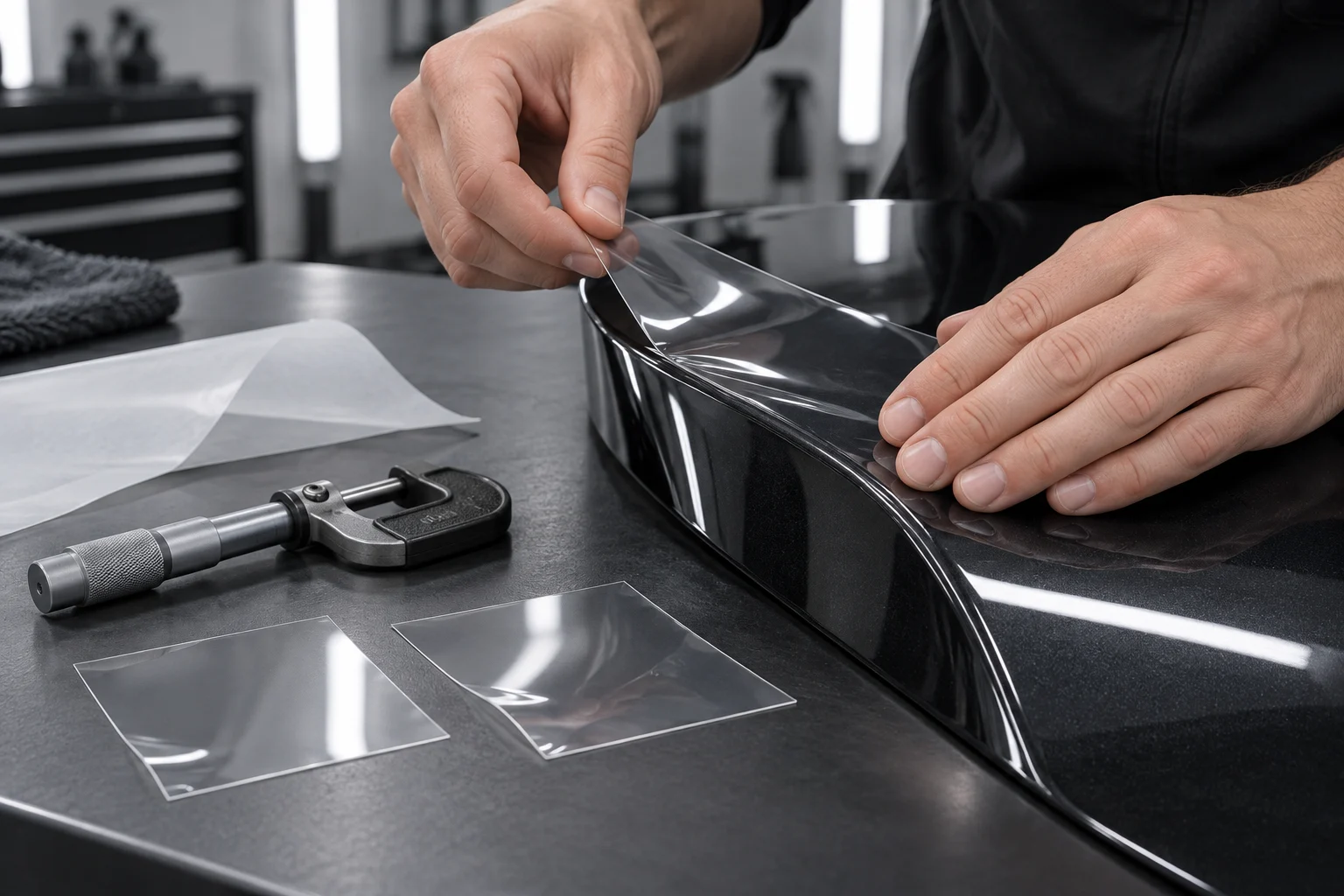
Flexibility: Manage Bend Resistance and Springback
Flexibility matters most where the film changes direction. On an open panel you can spread the material out; at a bumper return, mirror cap or recessed detail, you have less room to distribute it. A thicker comparable film asks you to bend more material through that space.
Watch what happens after positioning. A corner that sits flat while you hold it may pull back as the film relaxes. That springback leaves the adhesive resisting the film’s recovery force. The useful fitting result is a stable edge with controlled tension, rather than a corner held down through repeated pressure.
Give the film enough room to follow the shape before anchoring the edge, and follow its instructions for stretch and heat. Stretching can reduce local thickness as the material spreads. Pulling harder to make a heavier film behave like your usual lighter one can leave uneven material distribution, distortion or a return that wants to lift. Plan the fit around the product you are actually using.
Installation: Count Finishing Time and Rework
The thickness decision becomes a business decision when it affects completed jobs per roll and per working day. The roll price is only part of the cost. You also pay for fitting, finishing, discarded material and any return visit to repair an edge.
When introducing a thicker film, compare it on the same panel design through the complete fitting process. Pay attention to how often the installer lifts and resets a section, how easily water clears, and how the final return holds after fitting. Those observations tell you where the labor goes. A film that takes longer during positioning may still finish cleanly; one that seems quick initially may create extra edge work.
PPF Thickness FAQs
Do I Need Different Plotter Settings for Thicker PPF?
You may need to adjust the cutting setup when you change film. Thickness, capsheet and liner construction can affect the cut. Use the film and cutter guidance, then make a small test cut before running a full pattern. Check that the film separates cleanly without cutting through the release liner. Save the successful setup against the exact product, rather than using one setting for every roll carrying the same mil label.
Can I Replace a Panel with Another Film of the Same Thickness?
Match the original product where you can. Two 8.5 mil films can have different gloss, surface texture, coating behavior and adhesive characteristics. Thickness alone won’t give you a matching repair. Keep the product name and roll details with the installation record so a later replacement can be ordered accurately. View the replacement beside the existing film before fitting, especially when the original installation has already aged.
Should a Distributor Stock All Three PPF Thicknesses?
Carry the gauges your installer network has a clear use for. One regular clear film and one thicker option may cover your current orders; add a third when demand supports it. Before tying up cash in another full-roll stock line, look at repeat orders, product substitutions and requests you could not fulfil. A smaller range with dependable availability can serve your network better than three overlapping rolls that sell slowly.